High-Level Opening-Up and the Path to High-Quality Development of China's Offshore Finance
Lessons from policy-driven offshore finance practices in the United States, Germany and Japan. By Jing Jianguo (distinguished expert of the Shanghai Financial Association and director of the Offshore
Lessons from policy-driven offshore finance practices in the United States, Germany and Japan. By Jing Jianguo (distinguished expert of the Shanghai Financial Association and director of the Offshore Finance Research Institute). Source: 21st Century Business Herald.
As Chinese companies "go global," as RMB internationalization advances steadily and as the development of the Shanghai International Financial Center continues to deepen, offshore finance is an important tool for serving the cross-border operations of the real economy and meeting the cross-border financial services needs of foreign investors and eligible Chinese enterprises, and is also financial infrastructure that optimizes global resource allocation. Offshore finance also needs to return to its fundamental functions of reducing cross-border transaction costs and improving the efficiency of global capital allocation, while abiding by internationally accepted rules.
China should combine bold exploration with prudent control and coordinate policy leadership with commercial participation, drawing on the low-key, pragmatic and function-oriented offshore business experience of the Export-Import Bank of the United States (EXIM), IPEX-Bank under Germany's KfW, and the Japan Bank for International Cooperation (JBIC). It should steadily expand the scope of pilot programs for commercial banks' offshore finance business, improve institutional rules and the business environment, proactively align with international standards, and build a China-style offshore finance system that is risk-controllable and serves national strategy.
I. A cognitive bias that must be confronted
For a long time there has been a certain tension in domestic views of offshore finance: on the one hand it is recognized as a core function of an international financial center; on the other, it is easily associated with negative scenarios such as regulatory arbitrage and capital flight. This cognitive bias has resulted in insufficient supply of offshore finance and unstable policy, constraining the global financial functions of international financial centers.
Studying financial activity in the United States, Germany and Japan, we find that none of the three countries abandoned offshore finance; instead, they implemented related functions in a pragmatic, low-key, instrumental way. Japan built a centralized policy-driven offshore platform on the basis of JBIC's international financial account; Germany achieved legal separation between policy-driven and commercial offshore business through the independent legal entity structure of KfW Group and IPEX-Bank; and EXIM, with its countercyclical positioning and diversified funding channels, fills gaps left by private markets and provides offshore financing support to domestic exporters. The common lesson is that developing offshore finance does not require agonizing over whether to create a dedicated offshore license; the core is to proceed from national conditions and solve the two central problems of effectively serving the real economy and effectively controlling risk.
II. Revisiting the nature of offshore finance
The core of offshore finance is to provide comprehensive financial services for cross-border economic activity between non-residents, and between residents and non-residents, through an account system appropriately separated from the onshore market. Its basic functions include reducing cross-border transaction costs, improving capital allocation efficiency, blocking cross-border risk contagion and expanding international use scenarios for the domestic currency. Developing offshore finance is not optional for China; it is a functional financial need that inevitably arises as China's economy and finance become deeply integrated into the global division of labor.
In June 2026, six departments — the People's Bank of China, the National Development and Reform Commission, the National Financial Regulatory Administration, the China Securities Regulatory Commission, the State Administration of Foreign Exchange and the Shanghai Municipal People's Government — jointly issued the Action Plan for Developing Offshore Finance at the Shanghai International Financial Center, an important milestone in building China's offshore finance institutional framework. The plan sets out "three-step" phased goals, and following the principle of "implementing each category as it matures," priority is given to six categories of pilot business with a certain foundation: offshore trade financial services, free trade zone offshore bonds, offshore reinsurance, treasury center fund operations, offshore RMB foreign exchange trading, and financial services for non-resident individuals.
III. Deeper lessons from Japanese, German and US experience
(1) Japan's JBIC: a policy platform carrying offshore finance functions
Japan did not create a separate offshore banking license, nor did it fully open commercial banks' offshore services, but it relies on JBIC's international financial account to deliver centralized policy-driven offshore finance functions.
JBIC's international financial account and its overseas economic cooperation account are strictly separated. Under Article 41 of the Japan Bank for International Cooperation Act, the capital and reserves of the two accounts are managed separately, and the law explicitly states that the reserves of one account cannot be used to cover losses of the other, in line with the core risk control principles of account segregation and risk isolation in offshore finance. Its funding sources are highly internationalized: it raises funds in international markets by issuing sovereign-guaranteed dollar and euro bonds, then lends in the currencies of the countries where overseas projects are located, forming a closed loop of offshore fund-raising and offshore lending. Its overseas network covers global financial centers such as New York, London and Singapore, and its business has pronounced non-resident characteristics.
Since starting operations in Brazil in 1952, JBIC's cooperation with the Brazilian National Bank for Economic and Social Development (BNDES) has exceeded 60 years, with a credit line cooperation mechanism continuing since 2011. In March 2025, JBIC and BNDES signed their seventh credit line agreement, with total financing of up to US$185 million, of which JBIC contributed US$111 million, supporting green infrastructure projects such as Brazilian biofuels and power transmission under the GREEN business framework; it also serves the financing needs of large Brazilian resource companies, safeguarding the stability of Japan's critical minerals and energy supply chains. In November 2018, JBIC provided a financing line of up to US$60 million to Banco de la Nación Argentina (BNA) through its global bank loan mechanism, of which JBIC contributed US$36 million, with BNA on-lending to domestic importers to purchase Japanese infrastructure equipment.
The JBIC model offers this lesson: Japan concentrates offshore finance functions in a policy institution backed by national credit, positions it as a supplementary tool to commercial finance to serve domestic overseas industries and safeguard supply chain security, and does not blindly expand a market-based offshore market, forming a risk-controllable policy-driven offshore tool. China can draw on this centralized operating approach: relying on policy financial institutions, and focusing on Belt and Road cooperation and industrial chain security, it can establish long-term cooperation with financial institutions in host countries, build a business loop of offshore fund-raising, cross-border lending and on-lending in host countries, and confine cross-border risk within the balance sheet of the policy institution to prevent risk from spilling over into the domestic onshore market.
(2) Germany's KfW: legal entity separation as the institutional cornerstone of sustainable offshore finance
The German case answers the question of how policy-driven and commercial offshore business can coexist. In line with EU requirements for restructuring Germany's promotional banking system, KfW transferred its export credit and project finance business to a legally established subsidiary bank (IPEX-Bank) by December 31, 2007, and has been subject to full supervision under the German Banking Act (KWG) since January 1, 2008, no longer automatically enjoying federal government guarantees and holding an independent credit rating. The export credit business retained by the parent company KfW is limited to the framework of the OECD export credit consensus, using policy tools such as commercial interest reference rate (CIRR) subsidies.
The core logic of this institutional design is to use an independent legal entity to separate functions: policy-driven offshore business relies on national credit and is limited to strategic purposes; commercial offshore business operates fully on market principles; and KfW may not provide funds to its subsidiary at non-market rates, nor extend to the subsidiary any of its own maintenance obligations or federal government guarantee benefits, with cross-subsidization strictly prohibited.
KfW offers this lesson: the boundary between cross-border and offshore business of China's policy banks and commercial banks remains relatively blurred. In some cases, policy institutions use national credit to compete commercially, while some commercial banks are passively assigned policy tasks without risk compensation. Offshore finance reform therefore cannot stop at internal accounting separation; it needs to clarify the legal boundary between policy-driven and commercial offshore business at the institutional level to maintain a fair market order.
(3) US EXIM: countercyclical positioning and diversified funding to build a cross-border financial safety net
EXIM's core positioning is to remedy failures of the commercial offshore finance market: when commercial financial institutions withdraw due to risk considerations, or when domestic exporters face competition from other countries' policy finance, it provides cross-border financing support, with a distinct countercyclical character. When market liquidity is ample, EXIM does not compete with commercial offshore banks for high-quality projects; when the market declines and capital flees to safety, it steps in proactively, acting as a cross-border financial safety net.
EXIM has diversified funding channels, including government borrowing, equity, fiscal appropriations, retained operating earnings and market-based note issuance. Its long-term financial self-balancing capacity is strong, and it has returned net income to the Treasury for many consecutive years. According to EXIM's FY2026 Q2 default rate report, its default rate was 0.750% as of March 31, 2026, well below the statutory regulatory threshold of 2%. In February 2026, the EXIM board approved "Project Vault," providing US$10 billion in direct loans alongside about US$1.67 billion of private capital, with initial funding of US$12 billion, to build a strategic reserve of critical minerals equivalent to about 60 days of consumption.
EXIM offers this lesson: build a constrained countercyclical policy finance mechanism rather than unlimited fiscal backing; accumulate risk buffers during booms and release resources during downturns, while continuing to prudently assess repayment capacity. China's policy financial institutions can draw on three points in particular: first, adhere to the countercyclical gap-filling role, focusing on strategic cross-border projects with high country risk that commercial capital is unwilling to touch; second, broaden funding channels and optimize the liability structure to improve business sustainability; third, establish risk buffer pools and strengthen the financial discipline of policy business.
IV. Actively encouraging and supporting Chinese commercial banks to participate in offshore finance and building a coordinated ecosystem of "policy leadership plus commercial operation"
China's offshore finance shortfall is not a lack of policy finance tools, but limited breadth and depth of commercial bank participation and an obvious gap in commercial offshore finance supply. Since 2002, for a long period only four banks — Bank of Communications, China Merchants Bank, Shanghai Pudong Development Bank and Ping An Bank — held traditional OSA offshore licenses, which is seriously out of step with China's position as the world's largest goods trading nation and a major outward investor. Moderately expanding the number of pilot commercial banks for offshore business under controllable risk therefore has multiple strategic benefits.
1. Better meeting the real cross-border operational needs of the real economy. Overseas fund pooling, cross-border settlement, offshore trade finance and FX hedging by Chinese companies expanding abroad depend heavily on offshore accounts. If domestic banks cannot provide compliant offshore services, companies will turn to institutions in Hong Kong, China and Singapore, causing financial services to flow overseas and funds to sit abroad. In June 2026, the comprehensive reform pilot for offshore trade financial services in the Lin-gang Special Area was expanded, with ICBC, Bank of China, Shanghai Pudong Development Bank and HSBC receiving plaques as the first batch of "licensed" offshore business financial service institutions, confirming the advantage of commercial banks in serving real-economy clients and providing regular offshore financial services.
2. Moving the offshore RMB market from single-track overseas dominance toward coordinated onshore-offshore development. At present, offshore RMB quotations and liquidity are concentrated in Hong Kong, China, Singapore and London. In June 2026, PBOC Governor Pan Gongsheng announced at the Lujiazui Forum that ICBC, Agricultural Bank of China, Bank of China, China Construction Bank, Bank of Communications and China CITIC Bank were authorized to use the China Foreign Exchange Trade System platform to conduct offshore RMB spot, forward and swap transactions in the Shanghai Pilot Free Trade Zone. This will concentrate offshore RMB trading, quotations and transaction records in Shanghai, with commercial banks as core market participants helping to secure pricing initiative in the offshore RMB market.
3. Building a complementary and coordinated offshore finance ecosystem. Policy-driven offshore finance focuses on high-risk strategic cross-border projects that commercial finance finds difficult to take on; commercial banks' offshore business takes on market-based needs such as trade and treasury management and ordinary cross-border investment and financing. The two are complementary rather than substitutive. Without broad commercial bank participation, the offshore market lacks depth; without the strategic leadership of policy finance, business can drift from national strategy.
4. Maintaining a prudent approach to expansion at the institutional level. Where risk control systems are complete, priority should be given to selecting commercial banks with solid capital strength and a strong cross-border business base for inclusion in the pilot in batches, improving the coordination mechanism among OSA, FT (EF) and NRA account businesses, following the layered and coordinated pattern of "FT as the mainstay, OSA as a supplement and NRA as a complement," and guiding commercial banks to deepen commercial offshore business in differentiated coordination with policy banks.
V. Overall principles China should follow in developing offshore finance
Combining the practices of the United States, Germany and Japan with China's conditions for financial opening-up, China should adhere to the following: learn from experience but do not copy models; advance steadily but do not be passively conservative; encourage innovation but remain low-key and pragmatic; absorb selectively and reject wholesale transplantation.
1. Learn boldly, but do not copy models. JBIC's centralized policy offshore model, KfW's legal entity separation mechanism and EXIM's countercyclical mechanism are all rooted in their respective institutional histories. China needs to forge its own path: give play to the strategic leadership of policy finance and the market-based role of commercial banks, implement an account segregation risk control architecture, and clarify the regulatory and legal boundaries between the two types of offshore business.
2. Cross-border risk objectively exists, but reform should not be avoided because of risk. The key is to establish regulatory and risk disposal mechanisms matched to the level of risk. The Action Plan sets out "open up the first line, control the second line, retain transaction records and keep risk controllable," and pilot business must fulfill compliance obligations such as balance of payments reporting and tax-related due diligence. The next priority is to translate principles into implementable operating rules, advancing each category as it matures.
3. Encourage innovation but remain low-key and pragmatic, and communicate well internationally. JBIC does not deliberately publicize its offshore banking business, yet it steadily delivers offshore functions over the long term — a pragmatic strategy worth referencing. In the current international environment, however, transparency and explainability are important strategic resources; China should strengthen regular communication with the IMF, the BIS, the OECD and the supervisory authorities of major trading partners, explain its offshore finance regulatory framework and compliance requirements, reduce external misreading and enhance international mutual trust.
4. Absorb selectively and reject wholesale transplantation. Draw on JBIC's approach of using offshore finance to safeguard resource security and cooperate long-term with host-country financial institutions for Belt and Road business; absorb EXIM's countercyclical funding and risk buffer mechanisms to improve the governance of China's policy banks; and learn from KfW's legal entity separation experience to clarify the boundary between policy and commercial offshore business and maintain fair competition.
VI. Accelerating improvement of China's offshore finance business environment and consolidating the institutional foundation
Offshore finance competitiveness is essentially institutional competitiveness. China's current shortfalls are concentrated in the following: insufficient legal hierarchy for offshore finance, tax neutrality rules still to be refined, institutional fragmentation caused by multiple parallel account types, and cross-departmental regulatory coordination still to be strengthened.
1. Legal framework. China has no dedicated offshore finance legislation, with relevant rules scattered across departmental regulations, resulting in weak institutional stability and market expectations. It is suggested that preliminary research on offshore finance legislation be launched to gradually clarify the legal status of offshore finance, business access, account management, risk disposal and legal liability, raising the institutional hierarchy.
2. Taxation. The OECD's Pillar Two global minimum tax reform continues to advance, requiring multinational enterprises with annual revenue above EUR 750 million to apply an effective tax rate of at least 15%; in January 2026 the Inclusive Framework released a package of "side-by-side" measures setting out compatible arrangements. China's statutory corporate income tax rate of 25% meets the global minimum tax requirement, but the principle of tax neutrality for offshore finance and the detailed collection and administration rules still need refinement to stabilize market expectations.
3. Account system. Multiple account systems — OSA, FT (EF) and NRA — operate in parallel, with some overlapping functions and blurred boundaries that raise corporate compliance costs. It is suggested that the existing offshore-related account systems be optimized as a whole, the functional positioning of each account type clarified, institutional friction reduced and the benefits of FT (EF) and OSA reform released, optimizing account functions and opening up reasonable business scenarios while adhering to the risk control bottom line of "open up the first line and control the second line."
4. Regulatory coordination. Offshore finance business involves the central bank, the foreign exchange regulator, the financial regulatory administration, the securities regulator and local governments, with overlapping responsibilities. A regular cross-departmental offshore finance coordination mechanism needs to be established to coordinate pilot expansion, rule-making and risk monitoring and disposal, forming a regulatory synergy.
Accordingly, China should focus on six tasks: first, carry out preliminary research on dedicated offshore finance legislation; second, study and issue detailed tax collection and administration rules for offshore finance to implement tax neutrality; third, review the functions of OSA, FT (EF) and NRA accounts and simplify corporate operating procedures; fourth, improve cross-departmental coordination mechanisms and conduct stress tests; fifth, build an offshore finance risk monitoring and early warning system, strengthening transaction authenticity review, anti-money laundering, counter-terrorist financing and tax-related due diligence to hold the bottom line of no systemic risk; sixth, strengthen offshore finance talent development, promoting joint cross-border finance training programs between universities and financial institutions to build a professional cross-border risk control team familiar with international rules.
Finally, we must stress once again: offshore finance is not a monster, but functional financial infrastructure essential to an economy deeply integrated into globalization. Japan's JBIC, Germany's KfW Group and US EXIM have all delivered offshore finance functions within their own institutional frameworks. The shared lesson is that the focus should be on solving real economic problems, without being bound by a formal dispute over offshore licenses.
China's offshore finance reform has already taken a key step: the issuance of the Action Plan for Developing Offshore Finance at the Shanghai International Financial Center, together with the launch of six categories of pilot business and the offshore RMB foreign exchange trading pilot, marks the formation of a consensus on the strategic value of offshore finance. The next priority is to translate strategic consensus into implementable institutional arrangements, enrich the supply of market-based products and continuously improve international understanding of and trust in China's offshore finance system. Developing offshore finance requires balancing exploration with prudence and proactive action with a low-key, pragmatic approach, absorbing international experience while proceeding from national conditions. Throughout the business process, the risk bottom line must be upheld, the real economy and high-level opening-up must be served, and internationally accepted rules must be aligned with and accommodated. Only then can offshore finance become a strategic financial tool that supports Chinese companies in "going global," advances RMB internationalization and enhances the global competitiveness of the Shanghai International Financial Center.
Related Articles

PBOC Governor Pan Gongsheng Attends G20 FMCBG Meeting: China to Maintain a Moderately Accommodative Monetary Policy
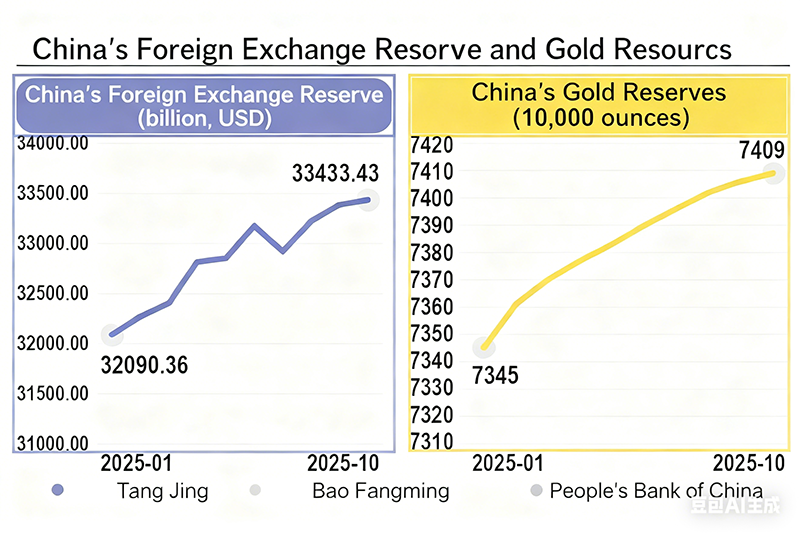
China's foreign exchange reserves exceed $3.3 trillion for three consecutive months as central bank adjusts pace of gold purchases

Global Financial Briefing | Friday, June 19, 2026: PBOC Fixing, CFETS RMB Index, MLF, LPR
China's M2 Up 7% YoY in Jan 2025, M1 Climbs 0.4%
State Administration of Foreign Exchange: Foreign investors net purchased $10.1 billion worth of domestic stocks and funds in the first half of the year