PBOC Governor Pan Gongsheng: Global Imbalances Cannot Be Corrected Through Exchange Rates, Central Bank to Keep Monetary Policy Moderately Loose
On October 15, 2026, the Group of 20 (G20) held its third G20 Finance Ministers and Central Bank Governors Meeting of the year in Bangkok, Thailand. The meeting discussed the global economic situation
On October 15, 2026, the Group of 20 (G20) held its third G20 Finance Ministers and Central Bank Governors Meeting of the year in Bangkok, Thailand. The meeting discussed the global economic situation and outlook as well as financial sector reform, among other topics. Pan Gongsheng, Governor of the People's Bank of China, attended and delivered remarks, and Xuan Changneng, Deputy Governor of the People's Bank of China, also attended the meeting.
Participants agreed that the world economy has remained broadly resilient but still faces multiple risks and challenges. Trade frictions and protectionism are weighing on the global economy by disrupting supply chains, pushing up inflation and unsettling market expectations. The financial sector is an important foundation for the efficient allocation of resources and steady economic growth, and participants supported improving the financial regulatory framework and safeguarding financial stability. They called on the G20 to strengthen policy coordination and promote global economic growth.
Pan Gongsheng pointed out that intensifying geopolitical conflict remains the biggest uncertainty for the global economy. Sharp swings in the government bond markets of some countries and the risk of valuation corrections in artificial intelligence-related assets have heightened financial fragility. Modernizing financial regulation does not mean loosening supervision, and it should not undermine the stability of the financial system or its capacity to withstand risk. All parties should make full use of the G20 finance track cooperation platform, strengthen macroeconomic policy coordination and jointly address global risks and challenges.
On global imbalances, he said a more comprehensive analytical perspective is needed. It is not enough to look only at the current account; financial channels also matter, and as global financial integration deepens, greater attention should be paid to the impact of capital flows and other financial factors on imbalances. Global imbalances cannot be corrected through exchange rates. Exchange rates are affected by economic growth, monetary policy, financial markets, geopolitics and sudden risk events, among other factors, and there is no simple linear relationship between the exchange rate and the current account. Deficit countries and surplus countries should work together to achieve dynamic equilibrium in the global economy.
Pan Gongsheng said China's high-quality economic development continues to show a sound momentum, its financial markets are operating steadily, and the fundamentals and supporting conditions for long-term economic improvement have not changed. The People's Bank of China will continue to implement a moderately loose monetary policy and create a favorable monetary and financial environment for stable growth of the Chinese economy and the steady operation of its financial markets.
Related Articles
PBOC Governor Pan Gongsheng Attends G20 FMCBG Meeting: China to Maintain a Moderately Accommodative Monetary Policy
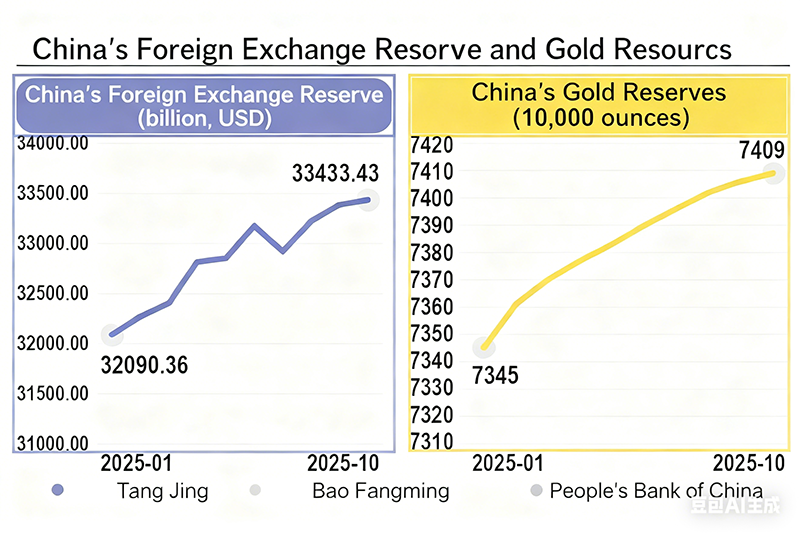
China's foreign exchange reserves exceed $3.3 trillion for three consecutive months as central bank adjusts pace of gold purchases
Global Financial Briefing | Friday, June 19, 2026: PBOC Fixing, CFETS RMB Index, MLF, LPR
China's M2 Up 7% YoY in Jan 2025, M1 Climbs 0.4%
State Administration of Foreign Exchange: Foreign investors net purchased $10.1 billion worth of domestic stocks and funds in the first half of the year