RMB Charts an Independent Path Against the Dollar: How Will the Yuan Play Out in the Fourth Quarter?
After the Federal Reserve delivered its rate hike, the dollar index rebounded and most non-US currencies came under pressure. Against a backdrop of a stronger dollar and a wider China-US rate differen
After the Federal Reserve delivered its rate hike, the dollar index rebounded and most non-US currencies came under pressure. Against a backdrop of a stronger dollar and a wider China-US rate differential, however, the renminbi has not weakened in sympathy — instead it has staged a rally of its own.
On September 28, the RMB central parity rate against the dollar was set at 6.7399, 90 pips stronger. The previous session's fixing was 6.7489, with the onshore yuan closing the 16:30 session at 6.7131 and the night session at 6.7125. Earlier, on September 18, both onshore and offshore yuan broke through the 6.7 mark, hitting their strongest levels since January 2023; after the key level was breached, the exchange rate shifted into two-way oscillation around 6.7.
The unusual trajectory has raised a host of questions: why has the RMB appreciated rather than depreciated amid Fed tightening? Will currency volatility deepen losses for A-share companies? And how will the yuan perform in the fourth quarter?
Why the Yuan Strengthened Despite Fed Hikes
After the Fed's hike landed, the dollar index rebounded and rate differentials widened — yet the RMB did not buckle, showing strong market resilience.
Market analysis holds that the move is not simply driven by rate differentials but reflects the combined effect of fundamentals, the FX settlement cycle and the regulatory framework.
"This phenomenon is hard to explain through short-term FX market logic alone," said Zhao Qingming, chief economist at Beijing Longhe Investment. From a fundamentals perspective, China's ample foreign exchange reserves are an important buffer against depreciation pressure, while the trade surplus lays a solid foundation for a stronger RMB. In addition, moderate appreciation lowers import costs and supports domestic demand — a factor that should not be overlooked behind this round of RMB strength.
Wang Qing, chief macro analyst at Golden Credit Rating, said the RMB's steady, slightly firm path stems mainly from a stable external trade environment, consistently strong exports and an economy that keeps improving, giving the exchange rate solid intrinsic support.
Notably, China has established a regulatory framework for cross-border capital flows that combines macroprudential management with micro-level regulation. Wang believes the risk of large-scale cross-border flows triggered by the policy cycle mismatch between China and the US can be effectively contained, so the Fed's tightening need not be overestimated as a drag on the RMB.
Tao Chuan, chief economist and chief macro analyst at Guolian Minsheng Securities, argued in a research report that the key to the yuan's strength amid overseas rate hikes lies not in the shape of rate differentials but in the structure of FX settlement. A company's return on holding dollars is determined by dollar interest income plus expected RMB depreciation. When dollar rates are high and the RMB is still weakening, holding FX is a positive carry and firms prefer to "collect dollars but not convert"; once the RMB turns from falling to rising, holding dollars becomes a cost and the conversion overhang starts to unwind.
The report notes that from December 2025 to May 2026, the goods-related settlement ratio climbed from around 59% to above 72%, as the RMB firmed from near 7.04 to about 6.78 — evidence that corporate settlement intensity systematically rose once the appreciation inflection appeared. In June-July the ratio eased but the RMB did not resume depreciating, indicating the steepest phase of unwinding had passed and a high plateau had been reached. In August the ratio rebounded to 66%, consistent with the traditional September settlement peak, a strong central parity and the offshore yuan outperforming the onshore rate.
Data show banks' client FX settlement surplus reached US$51.9 billion in August, up US$26.7 billion month-on-month. Wang Qing judges the surplus will stay elevated in September.
Will Appreciation Deepen Losses for A-Share Companies?
While a stronger RMB benefits importers, it also pressures export-oriented companies.
Zhang Yu, chief economist at Huachuang Securities, calculates from A-share earnings reports that since RMB appreciation accelerated in Q4 2025, FX-related costs for non-financial listed companies have risen markedly. In the first half of 2026, FX losses widened to 105.158 billion yuan, up 111.3% from the previous period, equal to 5.7% of net profit attributable to shareholders. Compared with historical episodes of similar appreciation, this drag on earnings is clearly greater.
Notably, looking only at the "FX gains and losses" line item misses the effect of currency hedging.
Zhang explained that gains and losses on hedging instruments are not booked under "FX gains and losses," so even companies that hedge their currency risk appear distorted on that line alone. Under accounting standards, translation losses on hedged foreign-currency assets and liabilities go to "finance costs — FX gains and losses," while gains on the offsetting forwards and options flow into investment income or fair-value changes and never touch the FX line.
Take Luxshare Precision: it booked 1.986 billion yuan of FX losses in the first half of 2026, but gains of 1.297 billion yuan on FX derivatives in the same period, leaving a net loss of only about 689 million yuan.
To gauge the true effect of hedging, Zhang selected A-share non-financial companies with overseas revenue of at least 50% of total revenue — firms with naturally stronger FX risk-management needs and a presumably higher share of FX derivatives in their trading.
The sample shows companies with heavy overseas exposure can offset part of their FX losses through investment income: in H1 2026, the sample's combined FX losses were 39.9 billion yuan, net fair-value losses 13.7 billion yuan and net investment income 30.9 billion yuan — a combined net loss of 22.7 billion yuan, 43.1% narrower than the raw FX losses. Even after hedging, however, this was the first half-year since 2016 in which the three items summed to a net loss; in past years the same period usually produced a net gain.
Zhao Qingming analyzed that appreciation lowers import costs and lifts demand for imported goods, stimulating domestic demand to a limited extent — but the core drivers of domestic demand remain employment and household income. By contrast, appreciation pressures exporters: listed-company data show export-heavy firms face obvious financial strain, and some low-margin companies have even slipped into losses. The shock to the export sector should not be underestimated.
For exporters, Zhao said, the most fundamental hedge against currency risk is to raise the technological content and global competitiveness of products and gain pricing power. With that in place, companies can maintain a relatively favorable position and stable earnings regardless of which way the exchange rate moves.
How Will the RMB Fare in the Fourth Quarter?
Since September the RMB has traded firm against the dollar overall, with the central parity rate rising for nine consecutive sessions from September 8 to 18 — a cumulative gain of notable size.
On September 18, both onshore and offshore yuan broke above 6.7 intraday, their strongest since January 2023. After the breakout, however, the currency did not keep climbing one way; it entered a two-way range, and onshore and offshore rates have recently oscillated in a narrow band around 6.7 with a modest pullback.
At the close of the third quarter, the yuan's Q4 path is the market's focus. A synthesis of institutional views suggests the fourth quarter will be shaped jointly by seasonal settlement demand and overseas policy shifts, with vigilance warranted against the dollar returning to a one-way uptrend.
The PBOC's Q3 monetary policy committee meeting made clear that the market should play the decisive role in forming the exchange rate, that the resilience of the FX market should be enhanced, that herd behavior and irrational expectations should be guarded against, and that the RMB's basic stability at a reasonable, equilibrium level will be maintained.
Wang Qing expects the RMB to stay steady-to-firm in the near term. Going forward, he said, watch China's export growth and the impact of major overseas central banks' policy shifts on the dollar index; he expects the yuan to trade largely inversely to the dollar within a relatively narrow range.
Tao Chuan cautioned that the real risk ahead lies not in US, European or Japanese rate hikes per se but in whether the dollar index re-enters a one-way strong phase; if the dollar merely oscillates around 100, overseas tightening imposes limited marginal constraint on the RMB. So long as the appreciation expectations generated by Chinese policy and trade scale are not broken, it would take a much bigger shock to push USD/CNY back into last year's territory above 7.1.
A Nanhua Futures research report noted the RMB was weighed down by pre-holiday dollar demand as residents traveling abroad and carry trades lifted dollar buying into the National Day break, pushing onshore USD/CNY close to 6.72, with the offshore yuan trading below the central parity and the counter-cyclical factor persistently negative — a sign of the authorities' stabilizing intent. Exporters' willingness to convert dollars is rising, but the yuan lacks short-term appreciation momentum. The report expects a "slow first, faster later" appreciation pattern in Q4, driven mainly by exporters' concentrated year-end settlement.
(Source: Yicai)
Related Articles
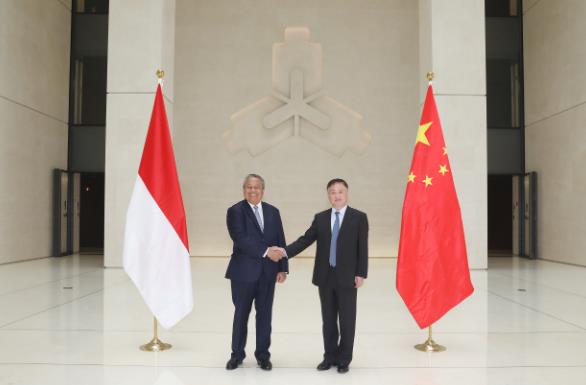
The People's Bank of China and Bank Indonesia jointly launched a bilateral local currency settlement framework and a QR code interoperability cooperation project

Zheng Shanjie Chairs Private Enterprise Forum: Boost Domestic Demand, Accelerate New Growth Drivers
Balancing Growth Stabilization and Risk Prevention: Central Bank Outlines Seven Key Tasks for Second Half of the Year

MOFCOM Spokesperson Responds to EU Commission Discussion on China Relations

The central bank will conduct 600 billion yuan in MLF operations with a one-year maturity