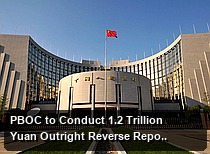
PBOC Deploys 800 Billion Yuan MLF and 500 Billion Yuan Reverse Repo Combo to Manage Liquidity Term Structure
On November 24, the People's Bank of China (PBOC) announced that, to keep liquidity ample in the banking system, it will conduct an 800 billion yuan one-year medium-term lending facility (MLF) operati
On November 24, the People's Bank of China (PBOC) announced that, to keep liquidity ample in the banking system, it will conduct an 800 billion yuan one-year medium-term lending facility (MLF) operation on November 25 through fixed-quantity tenders, interest-rate bidding and multiple-price bidding.
Photo source: PBOC website
At the same time, on November 25 the PBOC will also conduct a 500 billion yuan seven-day reverse repo operation through fixed-quantity tenders, interest-rate bidding and multiple-price bidding.
Data show that 516 billion yuan in overnight reverse repos, 1 trillion yuan in MLF and 80 billion yuan in treasury cash deposits will mature on November 25. Since 1 trillion yuan of MLF matures this month, the MLF rollover will be 200 billion yuan smaller.
Why is the MLF being rolled over at a reduced size again this month?
"In November, 1 trillion yuan of MLF matures, which means the rollover is downsized by 200 billion yuan — the same reduction as last month. Given that outright reverse repo operations of both tenors were also scaled back by 300 billion yuan in November, medium-term liquidity tools together shrank by 500 billion yuan this month, reversing a streak of four consecutive months of expanded rollovers," said Wang Qing, chief macro analyst at Golden Credit Rating. "Two straight months of smaller MLF rollovers and a shift to net drainage in medium-term liquidity operations mainly reflect recently loose market liquidity. Net drainage of medium-term funds by the central bank helps curb the downward trend in funding rates."
Data show the average DR001 (interbank overnight repo rate) was 1.28% in October, down 10 basis points from September. In November, DR001 remained low, averaging 1.29% through November 24, still well below the June–September average of 1.39%.
Wang Qing further explained that on October 19, PBOC Governor Pan Gongsheng announced at the 2026 Financial Street Forum Annual Meeting that the central bank would study switching the maturity of its main open-market operation instruments to overnight, with the overnight reverse repo rate becoming the corresponding main policy rate. On October 30, the PBOC announced that from November 2 overnight reverse repos would be tendered every business day at an operation rate of 1.25%, while seven-day reverse repos shifted to multiple-price bidding and their operation timing was moved to tax-payment and month-end dates. During this re-anchoring of the main policy rate, expectations of easier market liquidity kept building and drove bond yields lower relatively quickly.
"Therefore, the continued drainage of MLF liquidity in November and the shift of medium-term liquidity operations to net drainage send a clear policy signal. During the loose-liquidity period from March to June this year, medium-term liquidity was drained by 250 billion, 600 billion, 900 billion and 100 billion yuan respectively, which helped guide market expectations, curb the DR001 downtrend and prevent the market from speculating that the reform of the PBOC's open-market operation mechanism amounted to a rate cut," Wang Qing said.
Industry insiders: the central bank is paying more attention to term-structure management of liquidity
On November 25, alongside the 800 billion yuan MLF operation, the PBOC will also conduct a 500 billion yuan seven-day reverse repo operation, with the short-end backstop instrument acting in tandem.
Ming Ming, chief economist at CITIC Securities, told National Business Daily that November 25 coincides with the reserve-requirement payment date, when MLF maturities, the 80 billion yuan treasury cash deposit maturity and a peak in government bond payments overlap; the timely seven-day reverse repo backstop should keep funding conditions stable across month-end. The combination of "a 200 billion yuan MLF reduction plus a 500 billion yuan seven-day reverse repo injection" broadly meets market expectations, continuing the operational framework of fine-tuning at the short end and flexible contraction at the medium and long end after the policy-rate anchor switch.
Wen Bin, chief economist at China Minsheng Bank, said the 500 billion yuan seven-day reverse repo can be repaid after month-end, making it easier for financial institutions to arrange cross-month funding in advance as needed and helping smooth funding-rate volatility at end-November. Meanwhile, the 800 billion yuan MLF rollover will drain 200 billion yuan of medium- and long-term funds, which, together with the downsized outright reverse repo rollover in November, reduces redundancy in medium- and long-end liquidity and leaves more room for flexible short-end reverse repo operations, enabling more precise control of short-end money-market rates and keeping DR001 running smoothly close to the overnight reverse repo rate. The November 25 combination of a seven-day reverse repo operation and a smaller MLF rollover reflects the central bank's "shrinking the long end and expanding the short end" approach to improving the effectiveness of the monetary policy framework after the policy-rate re-anchoring.
Pang Ming, a member of the China Chief Economist Forum, said that from a policy-signal perspective, the combined MLF and reverse repo operations show that monetary policy continues to adhere to appropriate aggregate volume and structural optimization. MLF mainly serves medium- and long-term liquidity provision, while reverse repos focus on smoothing short-term liquidity. The simultaneous use of both tools indicates that the central bank is paying more attention to term-structure management of liquidity rather than simply pursuing the scale of fund injections.
From a policy-timing perspective, with month-end approaching and year-end funding demand continuing to rise, government bond issuance and payments, financial institutions' asset allocation and real-economy financing demand may all disturb market liquidity. Pang Ming believes that the central bank's early release of liquidity arrangements helps stabilize market expectations and smooth funding gaps around month-end and from exogenous disturbances.
Wang Qing said that looking ahead, various investment-stabilization policies are being implemented faster, government bond issuance remains at a peak, and after the 800 billion yuan of new policy-based financial instruments are deployed in October, supporting loans will follow — all of which require central bank liquidity support. "We judge that once market expectations stabilize, medium-term liquidity tools including MLF and outright reverse repos are likely to return to larger-scale rollovers to support government bond issuance and banks' supporting credit lending. This is an important focus of monetary policy stepping up counter-cyclical adjustment at the current stage."
Related Articles

Guotai Haitong: Moderate RMB Appreciation and Export Resilience Can Coexist, with Industrial Competitiveness the Fundamental Support
Two Ministries: New Power System Adapted to High Proportion of New Energy to Be Essentially Established by 2035
[DELETED]
At the end of January 2025, the balance of domestic and foreign currency deposits was 312.95 trillion yuan, up by 5.9% year-on-year.

Guan Tao: On the Economic and Policy Implications of 'Trade Surplus and Capital Outflow'