21-Month Buying Streak: Gold Prices Stage Strong Rebound—Is a New Upleg Beginning?
The People's Bank of China has continued to add to its gold reserves for 21 consecutive months. Data released by the central bank show that China's gold reserves reached 76.08 million ounces at the en
The People's Bank of China has continued to add to its gold reserves for 21 consecutive months. Data released by the central bank show that China's gold reserves reached 76.08 million ounces at the end of July, compared with 75.44 million ounces at the end of June. The July increase of 640,000 ounces, or about 19.91 tonnes, was the largest monthly purchase of the current 21-month streak.
Gold prices staged a strong rebound in the first week of August after a sharp correction in the first half of the year. The rally was fueled by U.S. dollar weakness. Domestic gold futures gained 5.46% for the week, silver futures rose 9.61%, palladium advanced 7.65%, and platinum climbed 9.21%.
Notably, the PBOC has adopted a contrarian accumulation strategy, increasing purchases as prices declined. Global central banks remained active buyers, with net gold purchases reaching 289 tonnes in the second quarter, up 62% year-on-year and a record for the period, according to the World Gold Council. Central bank demand has become the most important floor under gold prices, helping the metal remain resilient in a high-rate environment.
Retail investment demand, by contrast, remained cautious. Global gold ETF, bar and coin investment fell to 262 tonnes in the second quarter, down 46% year-on-year, with ETF outflows of 45 tonnes the main driver. In China, total gold ETF holdings dropped to 276.53 tonnes by the end of June from 298.29 tonnes at the end of March.
Looking ahead, CITIC Securities said the area around USD 4,000 per ounce is likely the bottom zone for this gold correction, while UBS believes gold could break above USD 5,000 per ounce by March 2027 if the Federal Reserve holds rates steady before cutting early next year, lowering real yields and the opportunity cost of holding non-yielding gold.
Related Articles

CSRC and Seven Agencies Launch Joint Crackdown on Illegal Cross-Border Securities and Forex Activities

MOFCOM Responds to Progress in China-US Economic and Trade Consultations and Other Hot Topics

Onshore Yuan Closes at 6.7817 Against Dollar, Down 33 Pips

China's Cross-Border Capital Inflows Reach $62.4 Billion in August as SAFE Says Forex Market Operating Steadily
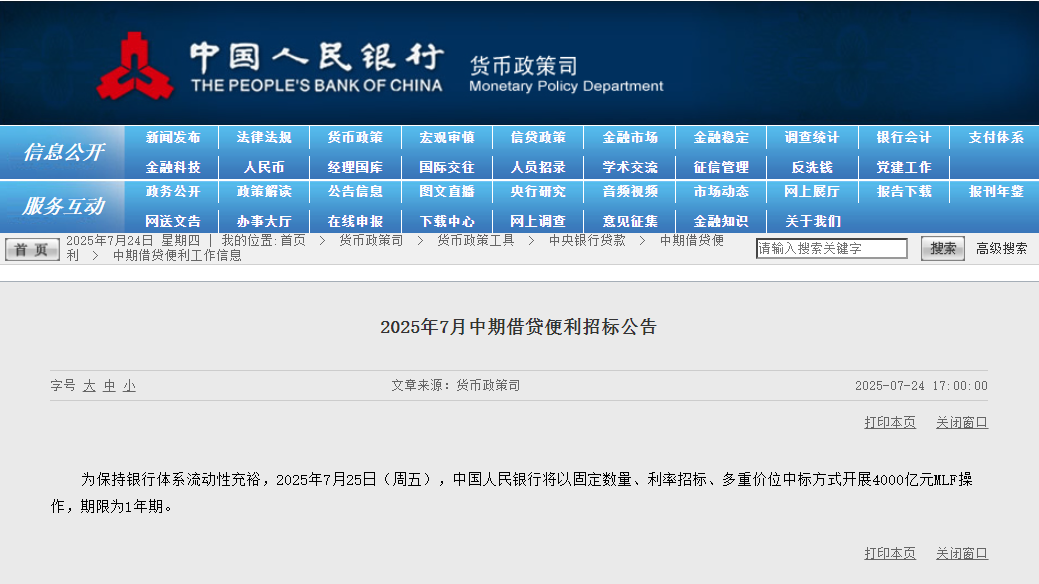
The central bank will conduct 400 billion yuan in Medium-term Lending Facility (MLF) operations on July 25