RMB's Role as an International Financing Currency Faces a Favorable Opportunity
Recently, Portugal's public debt management agency (IGCP) successfully issued its first offshore RMB bond through private placement, with a size of 1.99 billion yuan and a tenure of 8 years. Portugal
Recently, Portugal's public debt management agency (IGCP) successfully issued its first offshore RMB bond through private placement, with a size of 1.99 billion yuan and a tenure of 8 years. Portugal has thus become the first sovereign country in the euro area to issue offshore RMB bonds. Also this month, Kazakhstan's sovereign wealth fund Samruk-Kazyna JSC issued 3 billion yuan of bonds in China's onshore bond market with a 3-year tenure, marking the first Panda bond issuance by a Central Asian issuer and the first Panda bond with a sovereign wealth fund as the issuing entity.
Since the beginning of this year, RMB bond issuance has seen robust activity in both onshore and offshore markets. Taking Panda bonds as an example, Wind data shows that Panda bond issuance volume in the first quarter doubled year-on-year, and has been rising month-over-month since last September. Panda bonds have evolved from a niche instrument into a regular financing option for overseas issuers. In terms of issuers, the trend of foreign governments favoring RMB bonds is becoming increasingly evident: since the second half of last year, Hungary, the Emirate of Sharjah (UAE), Slovenia, and Portugal have successively issued RMB sovereign bonds.
Unlike overseas non-financial enterprises and multilateral institutions that primarily use proceeds for the Chinese market or RMB-denominated settlement, foreign governments that issue RMB bonds mostly convert the proceeds into local currency for domestic expenditures. While currency conversion may seem cumbersome and entail exchange rate risks, the RMB bond market's ability to attract an increasing number of high-rated international issuers is underpinned by clear low-cost financing advantages, ample liquidity from increasingly active onshore and offshore RMB trading, as well as stable RMB exchange rate expectations and continuously improving hedging instruments.
Behind the continuous deepening and broadening of the RMB bond market lies both spontaneous market growth and sustained optimization of policy mechanisms. In recent years, the convenience of cross-border use of RMB funds has steadily improved. Panda bond proceeds can be transferred in full across borders, accommodating both domestic operations and global fund allocation. Meanwhile, China's regular issuance of RMB treasury bills and central bank bills offshore has refined the offshore RMB yield curve, providing international issuers with a coherent and clear pricing anchor for RMB-denominated financing.
Market development continues to deepen through two-way supply-demand interaction. On April 22, the Chinese Ministry of Finance's issuance of 15.5 billion yuan of offshore RMB sovereign bonds in Hong Kong saw enthusiastic subscription from global investors, with multiple tenors achieving record or multi-year low issuance rates. Amid the current window of low interest rates, the RMB's role as an international financing currency is facing a favorable opportunity. Continuously promoting high-level opening-up of the financial sector, strengthening the supply of safe and liquid offshore RMB assets, and maintaining the basic stability of the RMB exchange rate at reasonable and equilibrium levels will provide solid support for RMB internationalization to reach new heights in the next stage.
Related Articles
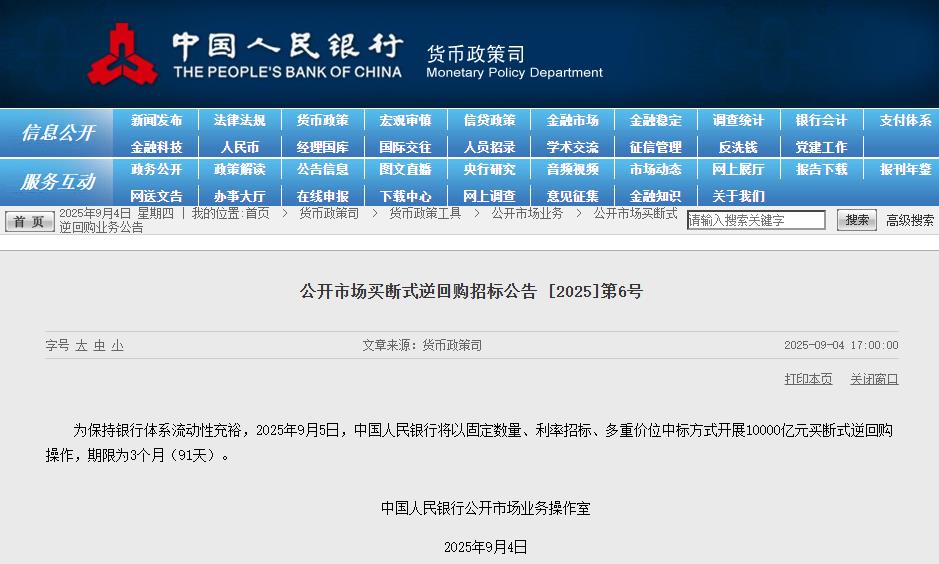
The central bank will conduct 1 trillion yuan in outright reverse repurchase operations on September 5

Global Turmoil and Central Bank Dilemmas: Where Is the New Anchor for the Global Monetary System?
Renminbi loans increased by 12.87 trillion yuan in the first seven months M2 balance at end of July rose 8.8% year-on-year

PBOC Governor Pan Gongsheng: Safeguard Stable Operation of Stock, Bond and Forex Markets

MOFCOM Responds to Progress in China-US Economic and Trade Consultations and Other Hot Topics